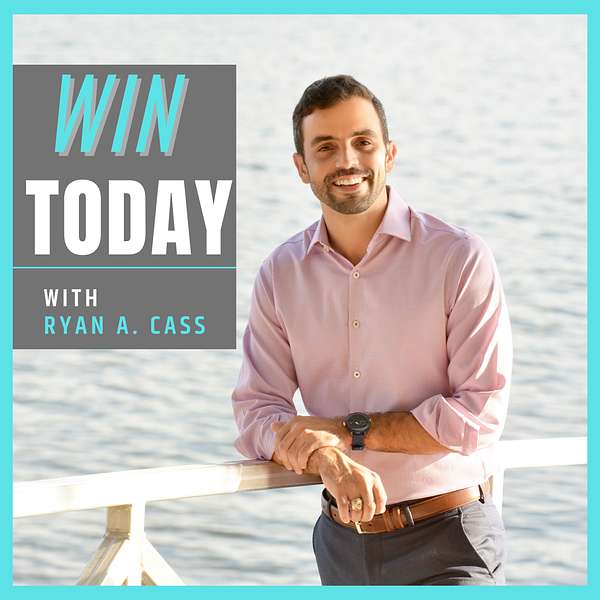
Win Today
Win Today is a performance enhancing podcast filled with actionable insights and inspiration to come out on top in life. Through captivating interviews and solo episodes, a powerful tool is created and given to listeners to be able to push through any situation in life.
Hosted by Ryan Cass, he delivers messages that align to his purpose of helping people establish a foundation for sustained success, break trends of adversity, and chart desirable courses for life. Win Today!
Win Today
#232 | More Than The Miles: Run Across South Carolina Recap - Answering Prayers
This breaks down the entire run across South Carolina, all 194 miles of fun. I share the heart behind Breaking Ribbons, the people who sparked it, and how purpose, planning, and community carried us through rain, injuries, police checks, and long miles on empty roads. We talk mindset shifts that mattered—reframing nerves, perspective shifts, and choosing gratitude when everything hurt. The real finish wasn’t the run itself, but raising over $20,000 to bless five families, starting with a mom heading into another round of chemo.
Key takeaways:
- Purpose changes how pain feels—and what it produces.
- Big missions are built on small details: logistics, people, and presence.
- Less than 1% of a year, done with intention, can redefine the other 99%.
Thank you for tuning in! If you feel led, please subscribe & share the show to others who you believe would benefit from it.
Keep in touch below!
When I think about the run and what we're doing, we weren't running. This wasn't a run. This is answering prayers to families that have someone fighting the good fight and are going through something infinitely more difficult than we're about to go through right before we step off this wrestling room and go on our way. When we look at things beyond what they are and connect them to a deeper purpose and assign deeper meaning to them, we will be able to push through the difficult moments. We will be able to answer the questions that we ask ourselves as to why did we decide to do this? Oh, that's right. We're answering prayers. Thank you so much for tuning in. My name is Ryan Cass, and I'm your host. My purpose in this world is to help push people further and harder than they believe possible and become unshakable in what matters most to them in their lives. Every week, you're gonna learn from either myself or a renowned expert in their field, and we're gonna unveil pieces of our playbook to help you win today. Please, if you love this show, subscribe and share it with somebody that will benefit from it. Let's dig in. I believe this quote encapsulates the journey that we just went on and I'm about to take you on right now. Behind every success story is a river of tears, a mountain of obstacles, an ocean of impossible odds, and an unbreakable warrior spirit. That's what I think about when going back and detailing the 194-mile journey across the entire state of South Carolina to provide to families that have a loved one currently battling cancer and going through something infinitely more difficult and more painful than what we dedicated three days of our lives to. So I'm gonna go through the whole process, everything from why to what happened during some challenges, and ultimately what we're doing now is a result of running across the entire state, which in my book qualifies as the third coolest thing. So the journey, the distance, the miles, that's neat, but it is not the ultimate highlight of this journey. The ultimate highlight is what's to come, as we're going to be blessing five families with over$20,000 this year in a time of need for them. So, with that, we're recapping why we went down this path and some stuff, some lessons learned along the way. And it's my wish that as I share this, that you get to experience the journey for yourself. And I'll do my best to paint the picture to where you're riding along in the van or running alongside me and the crew, and we'll go from there. So, for those that may be brand new to this channel, or you were led to this as a result of seeing the run for the first time, wondering who is this crazy person and who are these crazy guys doing this run. The reason for this run goes back to 2023. I launched Breaking Ribbons as a way to honor the lives of three people who are close to my heart, Anita Cass, Noah Mayberry, and Juliet Thomas Sofich, who each had a battle with cancer and they are no longer physically with us in this world. But I wanted to do something to honor their lives and make running, which is something very important to me, bigger than me. Meaning I don't run just to run. I want to run to inspire people. I want to run to help make the world a better place, to help improve lives of people in my network and the community, people going through something way harder. So I asked myself a question in 2022 with these three amazing people on my heart and in my mind. What's the hardest thing that I can do to honor them and to be able to provide to others that are going through what they went through? And what came into my mind and heart at that time was doing a 100-mile bridge run back and forth on the Ravenel Bridge here in Charleston, South Carolina, which we did on October 26, 2023. It was a 22-hour adventure, 20 laps back and forth non-stop. We raised$5,000 and blessed four families that year. So in 2023, I asked the same question with the intention of, okay, well, if$5,000 in four families is the new bar that we have set, how can we go further? How can we go harder? And ultimately, how can we help more people? How can we bless more people? That led to a 150-mile bridge run on October 26th, 2024. 43 hours raised just under$8,000, which we blessed another four families. Now, what's the question I asked to the in 2025? What's the hardest thing I can do? And now that we have a new bar set, it appears that we're increasing the distance by roughly 50 miles per year now. That I want to run across the entire state because it's roughly 200 miles. I can run from my hometown of Fort Mill, South Carolina, to now current hometown of Charleston. And let's see what happens. So that is the genesis of this. And I'm so grateful to say that we now have a new bar that has been set as we are going to bless five families this year, and we raised over$20,000, which still blows my mind to say. Over$20,000. And we actually broke the$10,000 goal before the event even started. One thing that's challenging with fundraising, or at least in my experience, what I've seen is that you have a lot of people that'll tell you, okay, yeah, I'm going to help you out, and that's awesome. And we're going to, we're, we're right on board. And then the event gets closer and closer and closer. And you know, people are liking your posts and everything, but the donations aren't flowing in. Then you start to wonder, okay, what's what's happening here? Are we going to raise anything? And even if we didn't hit our target, anything greater than zero is a blessing to these families that we'd be able to give away. But the amount of support that flowed in right off the bat was absolutely remarkable. So that's that's the the what and the why. You might be thinking, okay, what's coming for 2026? I don't know yet. What I do know, 100% certain, is that it will be over 200 miles. I don't know the route. I'm flirting with a couple options. If you have some ideas, anything that you think is absolutely insane, is up my alley. So I'm open for ideas and suggestions as to what the 2026 challenge can be. But ultimately, what I'm thinking about is how do we continue to raise the bar and bless more families, and we'll figure out the rest later. So that is really the why why we went down this path. It wasn't something that I had a random thought of going into this year. This has been systematic and it's been a been so amazing to see how it's continued to grow over time and how much people have come to support it. So I am incredibly grateful for all of the support, continued support, and all of the love that has flown in, flowed in this year, especially. This really took off. And I want to first spend time expressing my gratitude and thank you to everybody involved, whether you were a sponsor, a donor, a crew member, media, family, friends, combination of those things. We really had everything in 2025. To my crew in our van, Sean Rhodes, Coos, Shane Burke, Nick, Nate, our amazing camera guys. Thank you, doesn't do justice, but thank you, thank you, thank you again. Y'all are absolutely amazing to everybody in Jake's van. I believe Aaron, Bobby, Colin, Liam, thank you guys for keeping Jake afloat and for being out there, dedicating three days of your lives to living in a Ford Transit 12-seater van. Not the most luxurious accommodations, but y'all took time out of your lives to be out here and help make sure we had everything that we needed, Edwin, Jake, and I, to keep rolling. And I cannot express my gratitude enough. We had a lot of friends that came out and joined us along the way. We were on desolate roads pretty much the entire time. You can travel from Fort Mill to Charleston without ever hopping on a major highway. If you ever want to know the route, maybe you're curious about doing this yourself. You can take U.S. Highway 21 from Fort Mill to Columbia and then Highway 176 from Columbia to just outside of Charleston before you connect on to Highway 52, which then brings you all the way into downtown. So we had people joining us at all hours of the day. We had people that were meeting us on these desolate roads at various parts of the evening. It didn't matter that it was two o'clock in the morning on a Friday. We had friends coming out there, dedicating their time, which was absolutely incredible. People dropping off hot food, absolutely amazing. Sponsors, NAD underwear, cane footwear, LMNT, all day running company, Hydrofly Electrolytes, Sweet Feet Socks. I mean, blown away, truly, that these brands were getting behind us. Hall's Chop House, even putting out some recognition as well to Live Five News and Post and Courier, publishing amazing pieces that helped more people see this. Just thank you, thank you, thank you. So now let's get into the into the event. And right before the start, so the first lesson that really comes to mind that I want people to extract is that I see if you're nervous or have some doubt about something, take nervousness and doubt as signals that you're doing something meaningful, and take nervousness as doubt and any other emotion synonym that you may feel, maybe before you do something big, take that as a signal that you have put the work in and things are gonna go well. What I've found time and time again is that before I'm about to go into any major event or anything that is deeply meaningful to me that I've really put my heart into, that nervousness and doubt creeps in. Those thoughts of what if you don't make it across the state? What if things go wrong? What are people gonna think about you if you have to bow out at mile 120, 130? What if this fundraiser doesn't reach the level that you thought it would, and that you've really been putting out there in the world that it that it would reach? What happens? And I know that that voice will visit everybody, but I've simply reframed it to this is a signal that good things are coming. And this is completely normal. I say that as encouragement that this voice, it's totally normal for it to visit anybody. It visits the best of the best, the people that we often revere the most, that we may think, oh, they've just got it so figured out to where this voice of doubt never vis never visits them. The same voice that visits those folks that we love to admire, dream about, talk about is the same voice that visits you, it's the same voice that visits me. But what I what I know to be true over over time is that hey, things are gonna go well. That means you prepared, it means you care. If you didn't have those feelings of nervousness and doubt, then I would question, did you really prepare hard enough? And is your heart really in this? So nervousness and doubt are signals and a reminder that your heart is fully invested in whatever it is that you're about to do. And that's a good thing. So that was that was coming up, but I don't believe I've ever shared that those are signals. I like to look at them as signals versus spirals, where then I'm gonna have a tough night and second guess every little thing that happens, not sleep well, and go into the event not feeling excited as if I'm not ready, because those things are just not true. So those are signals, those are good things. Now I will say that I was so nervous on December 3rd, but really had so many signals that I wish we could have just started that night. I wanted to go, I was ready to get rolling. I didn't care if we kind of didn't care if we didn't sleep and just started running because I was also just producing so much adrenaline there in that moment, in those moments, that hey, let's let's get this thing going. But slept really well that night, actually. We had a later start on December 4th from Fort Mill High School. We waited until after school started, which I'll get into here in a second. But overall, it went into this completely well rested, knowing that the next three days was going to offer little to no sleep. And we were good. So next time that you feel one of those emotions, whether it is nervousness and doubt or something similar, whatever may come and visit you, I encourage you to reframe that as a positive signal that you've put the work in and good is to, good is to come, good is on your way. Now, getting into the day of the event, December 4th. There's significance behind that. And what I didn't share completely with the crew and everybody involved, a lot of people thought that we were, or may have thought, that we were starting on December 4th because that is my birthday. That is actually not the reason why we started on December 4th. So every year, the last three years of this run, I've aligned it to a date that honors one of the ribbons that are on my singlet. So the last couple years, we've started on October 26th because that is uh Julia Tomasovich, one of my best friend Andrew's mothers. That is her birthday. And I've started at 4:26 in the morning on the the first year we did this because that is Anita, Anita Cass, my grandmother. That April 26th, that is her passing date. So December 4th is actually Julia's passing date. So I aligned it to that, which also happens to be my birthday. But I think about there's no better way that I could have spent a birthday because I believe that the best gift that we can give in this world is to give back. So how cool is it that I can ring in turning 33 by kicking off the greatest challenge of my life thus far and running the longest distance of my life thus far. And we were starting at Fort Mill High School in the wrestling room because when I think about the two places that has really helped me establish the foundation upon which I live on today from a values perspective, from a discipline perspective and mindset perspective, it's the Fort Mill wrestling room being on the wrestling team and the Citadel. I credit those two places with so much of what I have in this life today. I really learned how to push my body and mind first at Fort Mill on the wrestling team. That was a place that was a safe haven for me when things at home, you know, my parents are divorced. Things at home were really challenging. Wrestling was my safe haven. I could go and brawl for two hours a day and let everything out, and in the and while doing so, become the most physically fit, disciplined person that I've ever been up until that point in my life. And I I love the sport of wrestling. There's no excuses. It's you versus the other person. It is, I believe, the purest form of of combat, and you can't be a great wrestler off of talent alone. It's not one of those sports that who's the best athlete. It's a sport that really digs into who's got the biggest heart, who's got the most enduring motor, and put those things, those two things together, and then let's go battle. So that's why we started there. I'm still very involved with the program and help out whenever I'm home. The wrestling coaches are still the same ones from when I was there, Coach Brock and Coach Marillo. I loved them to death. And they were gracious enough to bring the wrestling team into the room before we got started. And I got to speak with them. So I had my family there, mom, dad, sister, Christina was there. And then we had our crews, and the post and courier was there, and I got to share some perspective with the wrestling team, which the leads us into number two. So when we look at an activity for purely an activity, meaning if we look at running as just running, and it's not connected to something deeper, something greater, then when moments get difficult, we may be more likely to fall down a path, a cliff, a mindset cliff, meaning that we're only looking at this run as a run. Therefore, when it gets challenging, if we look at this run as just a run, then we can allow our possibly allow our minds to take over when it gets challenging, because it's not connected to something deeper and greater. I encourage everybody to, of the things that you do in life, especially the ones that have some meaning to you, to connect it to a deeper purpose, a deeper meaning, because it's inevitable that things will get tough. It's inevitable that there will be inconveniences. It's inevitable that you may question why you're even doing this thing. And it and it and that's for things more than just running in physical fitness. You may question why you're running a marathon, why you chose to run a marathon, why this was a good idea, or an ultra marathon. You may question along the journey of being an entrepreneur. You may question, man, is this really the thing? Like, money is not consistent right now. Am I really doing what I'm supposed to be doing? You may question a lot of things in life. If it's only looked at for what it is in that moment, it could be a lot easier to not continue, to not persist. Versus, here's what I'm getting at is the things that you are doing in life that have meaning to you. Either A make sure they're connected to some sort of greater purpose so that when it gets tough, you're able to lean on to the greater the purpose part and why you're doing this versus the activity itself. There's a story that I love to share. It's called the Stone Cutter Principle. There's three folks who are building a cathedral back in the back in the day. So many of us have seen the great cathedrals or churches, whether it be Notre Dame or I could go on and on. Think about a beautiful building that you've either seen a picture of or entered that was made of stone back in the day and made by hand without all the technology that we have right now. So there's a manager, construction manager that is that goes in and talks to the three men that are cutting stone. And he asks the first one, What are you doing? And he responds, I'm cutting stone. So all the first person sees is the activity he is doing as the activity. He can only see the activity for what it is. He goes down the line, the manager goes down the line and asks the second person cutting stone, What are you doing? And he says, I'm building a wall. So he's doing the same thing as person number one, but he's connecting to something greater than just cutting stone. He at least is connected to a task, which is better than just being connected purely to an activity. Not the best, but we're better. Now we go to the third person that's cutting stone. And the manager asks, What are you doing? And he says, I'm building a beautiful cathedral and a house of worship. He's doing the same thing as the other two guys, but he is connected to the greater purpose, the greater vision. So when it gets tough cutting that stone, or when it gets cumbersome or annoying, he's able to tie into I'm building a place of worship. I'm not just cutting stone. When I think about the run and what we're doing, we weren't running. This wasn't a run. This is answering prayers to families that have someone fighting the good fight and are going through something infinitely more difficult than we're about to go through right before we step off this wrestling room and go on our way. When we look at things beyond what they are and connect them to a deeper purpose and assign deeper meaning to them, we will be able to push through the difficult moments, we will be able to answer the questions that we ask ourselves as to why did we decide to do this? Oh, that's right. We're answering prayers, and you will persist. It is immensely important that the things that we do in life have a greater sense of purpose and meaning behind them because those inevitable things I mentioned before will come and visit you, and sometimes that's the make or break between a person that goes and gets something done versus a person that gives up on a dream because it's not connected to something greater. Let that sink in for a minute. Is there anything that you have in your life that you look at purely for what it is? Meaning, are you cutting stone and only see it as cutting stone? Are you cutting stone to cut stone, or are you building cathedrals in your life? That's my call to action. That that might be one of the most important lessons we share here. So that is the after I shared that, we walked out of the wrestling room into a gloomy 40-degree day, and had the whole wrestling team behind us, had family, friends watch watching alongside. We had our our two Ford vans, our Ford Transit 12-seater vans ready to roll. And Edwin, Jake, and I were off and had a nice applause there, and it was time to get going. So we were left at about 9 20 a.m. on Thursday, and that was it. I was so excited to just step off and and get going. Had no more nervousness and doubt. It was pure excitement, especially coming off of that talk with the team. And now I have what's fresh in my mind is hey, I'm not going on a run. I'm going to answer prayers. And that's what we're doing. That is exactly what we're doing. This moment that I told Edwin about in the middle of 2024 has now come to life. Edwin committed to doing this with me in, I believe, May of 2024, when I had sent him a text about this idea that I had. That here we go. And Edwin, I'm so grateful for you and the fact that you said yes without even thinking about it. And I'm grateful for your yes, as as we say here. And wow, what what an adventure. Nobody else that I would want to have alongside the whole time. And such a blast. So we're going. Roughly every 10 miles, our crew had a we had a meeting point with our crew. I actually drove the route multiple times to make sure that I knew where to go, but then also that we then so that the crew knew where to go as well. I didn't want to tell them, oh, just go find a spot 10 miles ahead. Uh everything was mapped out prior. One thing I messed up is that I thought, having driven the route in my Ponda Civic a couple times, you're being in a car versus being on the road, you may not see as much elevation. Now, South Carolina is not the hilliest state, especially going down towards the low country, but especially on the back roads, there are some deceiving. There are surprisingly, rather surprisingly, and there are a lot of deceiving hills, but surprisingly, a lot more hills and climbs than you would think, and some absolute monsters as well. So I knew it was going to be hilly going in from Fort Mill to at least Columbia, which that's where the bulk of the the of the hills were. But what I told everybody is that after 110 miles, it flattens out. I was wrong. That I clearly was being deceived in my in my civic, thinking that the last 80 miles are flat. And I believe that that uh that may have had an impact on on some folks. So it's not completely flat. I will say that. But every 10 miles, give or take, the crew would get ahead and go meet us there in the van. And it was so cool that especially as we're going through all of these very desolate roads, there's very, very few areas where we had sidewalk. That some of the aid stations that I picked out, I I picked as churches, thinking that, okay, especially as we're later on in the game, if things go really wrong and we really need either help from people or need to get shelter for whatever reason, a church is usually going to be a good bet, or at least we we believe that that's where we'll meet some of the nicest people. And sure enough, it was really cool to see that as we stopped at some of the churches and met the crew that were waiting for us to refill our bottles and give us nutrition, that there were members of the congregation coming out wondering, okay, what are these two vans full of random, random guys doing? And as they explained what we were doing, they got offered to the crew got offered to go inside. And if we needed to go in there for whatever reason, or shelter, use the bathrooms, anything, uh, they were all just opening us, welcoming us with open arms, which was really cool to see. Especially in Sandy Run, South Carolina. There was a gentleman named Juju that came out and spoke with us for a little while. I believe this was right after we took uh about a two-hour nap. He came out and we we talked to him about what we were doing, and he had shared that he's been a member of his church for 30 years, and and I asked him, where are we? He said, You're you're in God's country, son. You're in Sandy Run, South Carolina. It's like, all right. So I'm a fan of Sandy Run, South Carolina, and I believe it was the Beulah Baptist Church, something like that. So if you ever find yourself on Highway 176, know that the churches along the way, there are great people there. But yeah, every 10 miles we're rolling. I never want to see an uncrustable again until we do this next year. A lot of people were asking about nutrition. What were we doing? Uh, the van was absolutely stocked with everything from G1M, BPN nutrition gear. We had all of the electrolytes, LMNT, Hydro Fly that Ed got a hold of. Ed did such a great job getting a hold of multiple brands that were more than willing to send us gear and and help out. I remember reaching out to LMNT thinking, all right, they're probably not gonna say anything. I don't have a huge following or really the most, I would say, attractive social profile in terms of followers and well designed content, but they got back almost instantly and and offered support and asked where do we send where do we send these electrolytes to? I was thinking, wow, this is so cool. The van had probably, I believe, 12 boxes or more worth of uncrustables that I bought from Costco. We had peanut butter bagels, we had Welch's fruit snacks, we had candy, everything, everything. We had freaking everything. And the crew was amazing. Every time that we came to stop, really all we had to do, all I felt I ever had to do was give up my water bottles and say what I wanted in them for the next 10 miles and what I wanted to eat, and it was all pretty much given to us. Shout out, special shout out again to the crew. Sean Rhodes, Coos, Shane Burke, absolute MVP crew chief that went the extra mile. My only concern that I had for the crew and the camera team, Nick and Nate, is that they weren't sleeping enough. These guys were working tirelessly to keep us afloat and to pump out content along the run so we could continue to spread the good word. But Shane Burke, wow, what an amazing guy. First off, he's actually a cancer survivor, brain cancer survivor, and now Iron Man. Flies down from Philly to live in a van, makes a binder of all of our aid station stops, where we need to go, what we've eaten, emergency contacts. He's keeping the van organized because it looks like the van is literally eating people's shoes and food and everything. Wasn't the easiest to keep the van organized. And he's making sure that we're actually following the route, which you would think should be impossible to not screw up because it's stay down these two highways, but we did, and I'm to blame for one mist turn that added an extra mile, which good made it just a little bit harder. But Shane calls us and lets us know that we've gone off course, thankfully, with only one mile to spare versus several miles off course. This guy was on it, I mean, absolutely on it, and uh can't say thank you enough. So if Shane ever needs a crew, I will be there. And awesome, awesome. So that that covers the crew and really how we handled the stops. One question came in on Instagram about calorie burn. I believe we all burned around 30,000, if not more, calories. I know that my watch said I burned 28,672 calories. There is no way that I even came close to consuming that much between the uncrustables, the martin gels, the Welch's fruit snacks, the peanut butter bagels, the McDonald's pancakes, the diner pancakes, the rice, the bone broth, the nerds clusters. Yes, I'm can I've consumed all of these things along the three days. I don't know how much. Definitely a lot, definitely not close to 29,000 calories worth, but ate as much as humanly possible along the way. So yeah, we moved, we moved quite well. And there were two times that we took longer naps. We stopped around mile 70 and attempted to sleep for about two hours. I won't call out who exactly was responsible for making the van cool, but they did not, and the van was like a hot box for two hours, and I believe we spent more time sweating and than we did sleeping for that first attempted nap, but we did get to lay down and rest our legs, so there was that. Now, the second one, the folks were were better about making sure the van was actually nice and cool, and we got to sleep for about a little over two hours at mile 130. What's so crazy is that we didn't have great weather at all the whole time. For the first day, we were actually fairly fortunate in that we we had some rain, some sprinkles, but nothing too much. Uh, but days two and three were pretty much raining the entire time, up until the last two hours before the finish, it cleared up again. But the two times that we took our longer naps at about two hours, it was absolutely dumping rain. And nobody was checking radars to plan our naps around weather or rain. But I find it just so unique that the two times that we took naps based off of how we were feeling or how certain people were feeling, that is when it actually rained and dumped the most. So I believe that we really had a lot of folks and guardian angels and the big man and and people looking out for us, sending a lot of prayers. And that was a A huge, huge aid. Because I will say that one of the more challenging things was managing our all of the clothes and shoes that we had. We each brought multiple pairs of shoes, knowing that A, it's important to rotate regardless of weather, but B, that we were going to be getting weather. And one thing you don't want to do is run with wet feet because that will your feet will blister up way faster than running on dry feet. And when you go that distance, anything beyond a marathon, your feet are going to blister up either way. But the wet feet just intensifies it. So we knew that it was going to be a a battle with rotating shoes and rotating clothes, doing our best that we could to stay dry and warm. But that was that was, I would say, one of the things that we had to really work through was it's we can't change that it's raining. We can change our shoes, but that's only going to help us temporarily. We can change our clothes, but that's only going to help us temporarily. We're sweating through things. It's not like we brought a closet full of clothes. So sometimes you're having to replace wet clothes with less wet clothes and wet shoes with less wet shoes. But when I think through all of that, I wouldn't have it any other way. Didn't want it to be easy. It shouldn't be easy. The people that were serving the prayers of families that were answering are going through something way harder. So if you have wet feet, blistered feet for three days of your life, suck it up. Who cares? Good. Doesn't matter. We could have ended that at any point in time. The people that were serving, they don't get to choose when their battle ends. They don't get to choose, okay, for these three days, I'm not going to have cancer, and then I'll I'll resume the battle later. So the fact that we had the elements, the fact that we had to battle through the blistered feet, the chafing, everything, I believe made it certainly more special, but more resemblant of like the of what life brings people. We don't get to write all the chapters in the story. We don't get to choose we don't get to choose everything. We get to control the we only get to control the response. If we got to write all the chapters in the book, there would be no runs to honor people that are battling cancer because cancer wouldn't even exist. So I loved that we got to experience that suck beyond just what running 194 miles was gonna do because that has its own thing. Then you've got the sore muscles, the sore quads, the ailing ligaments, everything. Wouldn't have written it any other way. So that's now I'll jump into some more mindset specific things. I don't want to go through every mile by mile, and then I'll also bring up some of the more difficult moments that that we faced. So like I like I mentioned before, we're here's here's everything I'm grateful for in terms of the challenge that that we were delivered. So one thing that often kept me going mindset-wise, so I'll dig into mindset for a little bit. When things got challenging, when my blistered feet, which my feet had blood blisters on there that you would not want to see. I don't even think the people that have foot fetishes would want to see how disgusting my feet were during during this event. I remember around mile 40-ish, I believe, is when it started. And then you think, okay, wow, then you have 154 more miles to go, and your feet have already started chafing or sorry, blistering your ass. Yes, my ass. I think the worst part about this whole thing, because overall, physically, I felt felt pretty damn strong up until mile 172 where I had shin issues. I believe one of the worst parts about this entire thing was my chafed ass and gooch. Like the worst spot to be chafed because now you can't even run straight. And I apologize if that's too much information, but I'm being as real as possible that you want to talk about running and then feeling like you're scratching sandpaper between your freaking butt cheeks for over two days. Be my guest, come join. It was brutal. I if I I'll take feet blisters all day long. If I can figure out a way or if somebody knows a way, especially during wet conditions, to not have a freaking chafed ass, like please let me know. Because it seems like every ultra marathon, that is my arch nemesis, and it is not freaking fun to deal with. I would rather have leg pain, quad pain, whatever, than chafing pain. So as that was going on though, I would often smile, look up, and remind myself what we're doing. We're not running, we're answering prayers. I would literally look up and smile and just think about the families that we're gonna that we're gonna bless here soon. And I would think about Anita, Joe, Anita, Noah, Julia, and I know that they're that they're watching over and protecting us as well. But I would look up and and give myself that perspective shift. I'm like, you know what, this chafed ass isn't that bad. These toes, these these blood blisters that are literally scraping up against my feet right now, and it feels like there's razors inside of my shoe, it's not so bad. There's a lot of people that would love to have your biggest problem in life. I can imagine that folks that we're helping who are going through chemo right now would trade their what they're going through for a blistered foot any day of the week. They would go for it instantly. Oh, that's the worst thing that you have right now is a blistered foot. Okay, you know what? Sign me up, I'll do that. Meanwhile, we're thinking that this is the worst thing in the world and all hell is about to break loose. So there is somebody in this world that would love to have your biggest problem, but also remember that it's so important to connect what you're doing to something greater than that activity itself. So that was the thing that I really relied on the most from my mindset perspective. And the other thing is someone asked, like, how has this evolved over time? So I always look for reframes, or I remind myself of a few things that like I said earlier, hey, you've got blistered feet, good. Because that's gonna make you better, it's gonna make you tougher, it's gonna make you stronger. That's a that's a mindset shift. You're out here, this sucks. Hey, you're you're answering prayers, awesome. What's on the other side of pain? What's on the other side of a difficult moment? What's on the other side of a blistered foot and enduring through that? What's on the other side of pushing past the chafed ass and gooch? A better, stronger, more capable version of you. One thing I love that Ed Milette says is on the other side of pain is a better version of you. So knowing that just by staying in the fight, by staying in the arena, you are going to meet and encounter a better, greater, ultimate version of yourself, but it's only available if you keep pushing through. You've got to persist. But that's what's on the other side of that. That keeps me going. Another thing that has evolved this year, especially, that I'll tell myself during marathons. I started using this in Boston this year, is when things were getting difficult and voices were getting in my head, or the pressure was mounting. That man, what if you don't break three? You've told all these people all these things, etc. I reframe what I'm doing to, hey, I'm out here setting a great example for people and helping plant a seed in at least one life. To do something more challenging, to do something challenging for themselves, to do something meaningful for themselves. I think about a promise that I made myself when I was six years old after a really challenging night at home, seeing my parents go through, go through something very difficult that I promised myself in that moment that I'm never gonna put my future family through this. I'm never gonna, I'm not gonna carry on this trend of alcoholism in my family. I promise that that's not gonna happen. I often think about my life and I think, man, I'm just a man that's keeping a promise to a little boy. And doing these activities, whether it's a marathon, whether it's giving back, whether it's volunteering, a lot of the things that you see from me, I'm out here fulfilling a promise that I made to little Ryan. And that makes me smile, that makes me find extra strength and meaning in difficulty. So that's really I would say everything I I use and used from a mindset perspective. And I look to add on reframes from time to time, and I'm constantly seeking those things, but that's really what I see. And what I was telling Ed and Jake along the way that, man, how cool, how cool is it right now? Look what we're doing, guys. You know, at two o'clock in the morning on Friday or Saturday. Look what we're doing, guys. How cool is it that we're answering prayers right now? What an opportunity, what a blessing. How cool that we can use our bodies as vessels of service to others. So I encourage you all to again, if you don't have a mental reframe, I'm wishing that maybe I just gave you one or helped create one for yourself. But we should all have mental reframes that we can use that when it gets difficult in the arena, because it will, we continue to push forward. The other thing that I would say really helped is I've been really focused this year on being, like simply being, just enjoying and noticing the surroundings and the world around me. More so than I ever have. Like it is, it is I'm not sure exactly what it is, but I've been way more in tuned to the environment and being able to slow down, listen to the birds chirp, see trees and branches, everything that I've been walking past for years or running past in this case, and noticing the environment and really being in more in awe of of all the beauty that surrounds us. And even being on these desolate roads in the backcountry of good old South Carolina, I found myself really just being in such appreciation for everything around. Like, how cool is it? We're we're running past a cotton field right now. Like I've never seen a cotton field up close. How cool is it that as we're going through these remote areas that there are goats that are on top of haystacks right now, and they're looking at us like, what the heck are you guys doing? We've never seen runners coming down here before. Appreciate simply being. She was a former Emmy Award winner and now children's author. And at the time when I interviewed her, she had stage four cancer. She's battling stage four cancer. And I asked her, what would she say to people that weren't in her spot right now? So her being a stage four cancer fighter, what would she offer as advice to you and I? And she said, watch the squirrels play a little bit longer, sit down in the park, listen to the birds sing, look at the leaves blowing in the wind, and just be. And I remember taking that to heart, thinking about, man, there's so many things that I believe I know I've missed because either I'm distracted or I'm thinking about I need to be in the next place. It's we don't have time to waste and how much we can hold for granted, how much things that we can, how much beauty we left we leave unseen because we don't take time to slow down and appreciate it, smell the roses. We never know when when this life may end. We never know when holy smokes, that we face an unexpected battle with cancer. So as we were going along, it was really cool just to be, not think about anything. I didn't use headphones or really listen to music at all throughout the time, just focused on being and staying locked in and in immense appreciation and gratitude. And I believe that that's an important thing for people to do. So getting into some of the difficult moments, some of the some of the standout moments. Uh there's there's a lot that you can go through along 194 miles with with a couple guys and and and a bunch of crew members that you just you never know. Now, one thing that didn't happen, at least for me, that I was expecting to happen were hallucinations. I didn't see anything like I have before. I've I really felt incredibly locked in this entire cognitively the entire time. Uh certainly got tired, but never really felt really woozy or started seeing things. So I'm very grateful for that. I know that I believe Jake apparently saw traffic cones and and asked someone to move a traffic cone that that wasn't there. I don't believe Ed hallucinated either, but I I could be wrong. So he'll he'll let me know if I was wrong. But I know that we all were were at times in immense physical pain that Ed had the the feeling in his shin of uh for us that that road razor scooters, y'all know that spinning that scooter around and when it would hit your shin, if you didn't time things right, it's a pretty freaking brutal feeling. I believe around 130 or 140, mile 130, 140, that's when it came up for him. I was definitely nervous for him for a while because he had his whole shin wrapped up and everything. And and Ed being as tough as he is, I know that if he had to do that, that the pain must have been immense because he wouldn't do that if it was just hurting a little bit. It would have had to been hurting a ton. But that speaks to Ed being an absolute warrior and and fighter that he is. Now, I did give him a tough time for pulling out poles because I believe that you should only be using poles if you're you better be climbing damn Mount Everest or or going up Leadville if you're using poles, not in South Carolina, but I know that that was something that really helped him. And and so it's it's okay. But I will say now that he was being a little bit of a Susie with the poles. But I love you, brother, and I told you that when I was next to you, so but uh and I know Jake had a whole monstrosity of of issues as well, a lot of times where he was holding people, you know, had had his crew holding on, holding on to them over the shoulders and a lot of moments around mile 172. It feels like the shin pain. Maybe this is my karma for making fun of Ed's poles, that I felt the the shin pain as well that I've never felt before in my life or in my running career, never had shin issues, but same thing where it literally felt like someone kicked me or that I slammed a scooter along my shin and it stayed pretty swollen, and I couldn't see my ankle for about a week. So yeah. Brutal, brutal pain there with the shin and definitely changed changed our running gait quite a bit. There were a lot of times where we we walk, we we power hiked the uphills, but there were times that even running for a tenth of a mile was incredibly, incredibly painful. And it felt like a tenth of a mile at times was one mile. So but again, how beautiful, how awesome, what a gift, what a blessing it is to suffer as Sean and and and Ed say. So tough ones that stood out in particular were about mile 160 or 70. We were completely on the grass. So there were a lot of roads that were were on back highways. So we're running along the whatever little piece of road we can that is out of the way of cars and at times using the road when we can, but oftentimes we're jumping out of the road to get on the grassy section, which is very uneven and actually quite scary in some areas because there was very little margin for error. And it was a little nerve-wracking to think we already live in a very distracted world as it is. If these drivers are not paying attention and texting and driving and they go just off to the side a little bit, we're we're toast. Not a single instance where we had to jump out because a car almost hit us or where anything fell off of an 18-wheeler. Like we truly were well looked after. So the about mile 160 to 170, there was a seven-mile stretch where the road was so busy that we had no choice but to be in the grass. It was raining a ton. We were cold, we're chafed, we're Ed and I have have the shin issue. We're both going through. Jake is really struggling. And this six-mile stretch is purely uphill. We're getting pelted, and it it feels like it's never ending. I believe one of the worst things that someone can tell you if you're if you're going through an ultra and you've got a crew member or somebody or a pacer, I believe one of the worst things is them telling you how much further you have to go. Because now you're internalizing what six miles should take and what it feels to you versus what it actually is, versus I believe the best thing you can do is just say, hey, we're we're up the road a good ways. Now after that, just shut your mouth. Don't ask a thousand times, are we there yet? Are we getting closer? Are we getting closer? That was one thing that got a little frustrating was hey, we'll we'll we'll we'll we're there when we see the freaking van. Let's keep going. So this six-mile stretch, though, in the rain along the grass with uneven surface, very hurt bodies, and completely soaked feet sucked, absolutely sucked. Another tough stretch was around mile one tennis or so, where we got pulled over on foot, not for going too fast. That's the joke people have, not for going too fast, but uh we got pulled over three times within a mile and a half span from Calhoun County police that I guess there were complaints, or we'll call them concerns from people that there's three random guys running on the road, and we're concerned that they're not getting out of the road fast enough or that they're gonna get hit. So we get pulled over. I tell the police what we're doing, and I'm the founder of Breaking Ribbons. Here's we've got we're going to Charleston. They say, okay, please stay on the grass as much as you can. Go on the road when you need to. And we go not even a mile, get pulled over again. I don't know if these officers spoke to each other or not, but please stay off the road. We're looking out for you. We keep going again, pulled over. And this cop offered us if you need police escort, if you need lights, we'll help you. They were all very gracious. They were all doing their jobs too. That they can they can help us out. But that certainly made us spend a lot more time in the grass than in the road, probably because we were paranoid at this point that we're gonna get pulled over even for being in the road when there's no cars. And I don't want anything to compromise this journey and have police officers say, you're done. We don't care what you're doing. You've we've had four people come and see you now. So that that definitely made us spend a lot more time, I would say, in grass than road, which sounds like not a big deal, but we're talking about completely switching surfaces, completely switching our gait, working completely different muscles, everything. So there was there was that. The third most difficult moment, I would say, was actually as we were approaching the citadel. So that was the ending point. We ended at the citadel. It's uh actually Edwin and I is alma mater, but that's the second place in life that really taught me how to do hard things and do things that are bigger than you and be of service to others. Going into the citadel, I believe we're all mentally just wanted to be done. This is where minutes go by like hours, and hours go by like days that time is not moving very fast. We're all we're all mentally envisioning the finish line being right around the corner, and and it's not there. And that's where it's also fun just to keep good spirits, laugh and smile as much as you possibly can. I love this speech from Admiral Bill McCraven. Y'all may have heard this years ago, but if you haven't, a great speech to watch is the University of Texas commencement speech. It's popular enough on YouTube that the one that will pop up will be the one with Admiral McCraven, former Navy SEAL. And the thing that people remember most from his speech is if you want to change the world, start off by making your bed. He talks about 10 Navy SEAL lessons that apply to real life. The one that I love the most is he talks about this story at SEAL training where they are in mud and they're getting wet and muddy. It's a cold night in Coronado, California, and one of the SEAL candidates starts to sing as they're crawling through mud. And now the Navy SEALs are threatening this one candidate. If you don't stop singing, like we're gonna torture you all night, and this is gonna suck. And what it what happens is now another person starts singing, and another person, and the whole class is now singing, singing in unison, although they're being threatened by the SEALs that you guys are about to have the worst day ever. But as they started doing that, what happens? The mud starts to feel a little bit warmer. It doesn't suck so much that they're crawling through mud. So Admiral McCraven says, if you want to change the world, make sure to sing when you're covered in mud. I I interpret that too. If you're going through something tough, make sure you're smiling and find find a reason to smile, find some find some joy so that you can keep going. So I would often smile, sing some songs in my head, or joke around with with the crew. There was at one point I attempted to copy a Ric Flair quote that a lot of people may not may not have understood what I was attempting to do here, but there's a a Ric Flair quote that uh he says, you know, I've I'll be I'm the wheeling dealin', Rolex wearing, diamond ring wearing, jet flying, son of a gun. And I think people thought I was just being delirious, but I'll I'll see if I can if I can play it here. We'll see if that picks up or not. And I'll see if I can layer in the uh the actual Ric Flair audio as well. But that's what I was attempting to embody. Uh more so to make myself laugh and make others laugh and show that, hey, when you're going through something challenging, just you can you can sing your way through it. You can find joy. You can find joy in almost anything in life. So there's there's that. We finished around three o'clock in the morning on Sunday. And I what I originally envisioned was that we would have been there Saturday night and had a large crew of friends and and whatnot, but it was a good opportunity to a good ego check opportunity for me too. I know that we were we I certainly wanted to be done by and and predicted we would have been done by maybe Saturday night around eight o'clock, nine o'clock, maybe ten. And that would have been early enough for a whole slew of of people to come out. But at the end of the day, that's that's not even what what this whole thing is about, anyways. But we still had friends coming out at three o'clock in the morning on a Sunday to to be with us there as we finished at the Citadel. And those those closing steps, some of y'all have seen the video. If not, go go check it out on on one of our Instagram pages. I wouldn't really call it a run that we that we did across the finish line, but we did, it was more than a walk. It was something. And it was really really amazing, so so rewarding to to be done, to have people that were trailing us the whole way, and people that that came to to be there for the very end. So special at a very special place for for myself and Edwin, I know. And I remember hugging Edwin and Jake there, and it's expressing my gratitude to them that hey, they didn't have to do this, and this isn't even their their organization, but they they battled through, they got it done, they helped rally people around the cause as well. And ultimately, you know, now what we're doing is starting on December 26th, we are blessing five families. The first family has already been identified, and it is a woman who's 46 years old, just finished up a round of chemo recently, about to start another round, has an eight-year-old son and really, really struggling and in need. So she does not know why she is going to be attending this meeting on the 26th, why she's being asked to go to the nonprofit workspace that that we're going to be meeting at. But she will soon know that she is the recipient of I would say y'all's fruits and labor, our fruits and labor, and there will be four more families. So that is the the absolute highlight. One thing that looking back on this and for more perspective, we spent three days on this journey. Three days out of 365 days in a year. Less than one percent, if less than one percent of my 2025 was really freaking hard, but can create a lasting memory and moment in multiple families' lives that will extend far beyond 2025. It is so worth it. But think about that for your life as well. Sometimes we think, I believe I I hear people talk about, man, this was I don't want to do that. That's that's way too hard. Some of these challenges and things that we deem is too difficult in our minds literally represent less than a percentage of our life and our year, but can give us benefits and returns for an entire lifetime. This experience right here in 2025, less than 1% of 2025 is a defining moment for 100% of 2025. This was certainly a defining moment of 2025, and it took less than 1% of the year, it took three days. Less than 1% can be a defining moment for 100%. Let that sink in. And when you think about this on a timeline of life, assuming that I get to live for at least 80 to 100 years, this three-day journey literally represents 0.000005% of my life that will pay dividends for decades and plant seeds in other people's lives for decades, and generations rather. It doesn't take doing a bunch of grand things, my friends, to make an em to make a major impact in this world, or it doesn't take even spending a ton of time. This was less than 1% of the year. Yes, a lot went into it, a lot led into it for sure. But we can trade a little investment for a ton of return, infinite return, rather. It's my wish that by taking on these challenges that it that it inspires at least one person to take on something meaningful for themselves. It doesn't need to be a marathon, it could be anything. Something that's close to your heart. I believe that's the second coolest thing about this whole adventure. You know, number three was the run. This was more than a run, but it's really the third coolest thing in my view. The second is the positive impact, the ripple that comes from this. The first are the blessings, the answered prayers, what we're doing now. Another amazing thank you. And now highlighting Nick and Nate specifically, Nick Benton, Nate, Nate Benzwitz, our camera guys. Uh, there will be a documentary that follows this, but those guys worked tirelessly in the van, incredibly inspiring. I believe they slept just as much as it maybe even less than we did. These guys were not only filming us along the way, but then had their laptops, they're working on hot spots in a stinky, sweaty van that's literally messy with wet shoes, clothes, everything, and they're pumping out amazing clips that we can put on our on our Instagram throughout the entire run. What did that ultimately lead to? It led to more donations, it led to more awareness, it led to the world finding out what we're doing, it led to the news reaching out to interview me afterwards, like so much that came from that. But they are true professionals and craftsmen, and I was blown away by by what they were doing, and it made me want to push harder. So huge thank you. Documentary is coming. We will have updates of the five families that we're gonna bless. Another big thank you to Edwin Martin that really put put a lot of his heart into this as well, and getting the word out and the training and reaching out to companies, it's so much. I I couldn't have asked for a better right-hand man with that. Uh, to Jake for enduring, you believe you went through the pain cave a lot longer than we did. And there were certainly times where I questioned, I don't know if you're gonna make it, and you did. And you had your your crew with you that that helped you and stick stuck with you the whole time and kept you going, literally had your arms around their shoulders for a long time. And uh, I respect anybody that will get in the arena and stay in the arena because there's a lot of people that jump in and jump out. To our crew again, to family, mom coming out with bone broth with Christina to coming out, meeting us at various points, various sections where y'all aren't sleeping much as well either. To all of our donors, to Mike Carter and eGroup for the generous donation and match that was completely unexpected. So many thanks, so many thanks to come. But ultimately, I'm I'm so grateful that we get to do what we get to do now, which is answer prayers. Remember to help, remember to connect to greater and deeper purpose in life, and that will help you push forward, that will help you live your dreams, and it will help you win today. Thanks so much.
_pp.JPG)